

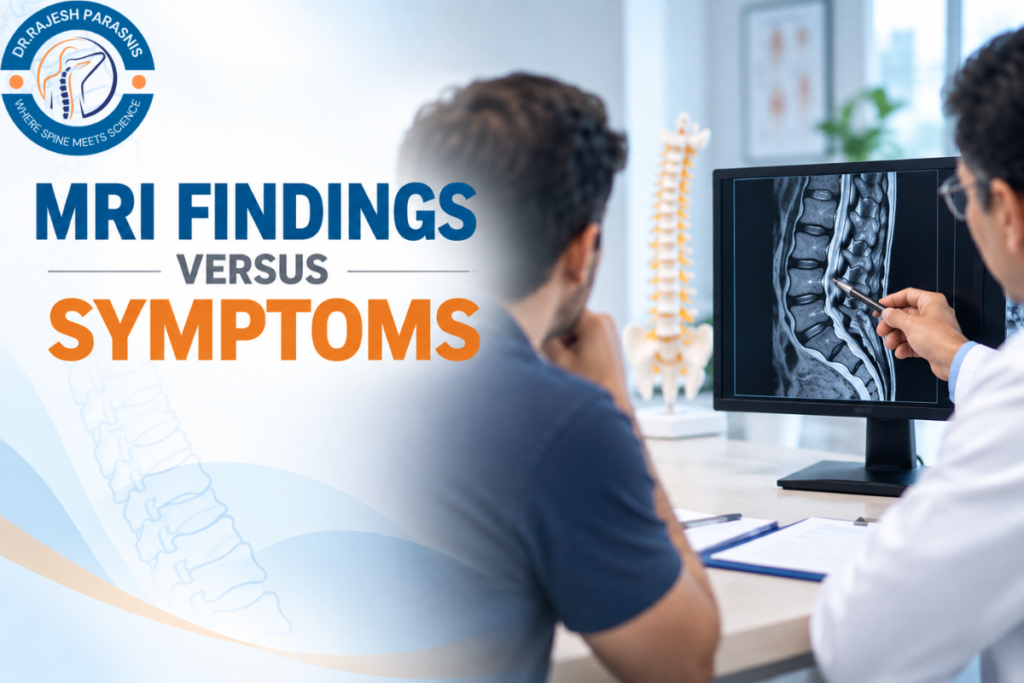
Have you ever looked at your MRI report and felt worried after reading terms such as disc bulge, degeneration, nerve compression, spinal stenosis or spondylosis?
It is natural to feel concerned. However, an important point in spine care is that an MRI finding and a patient’s symptoms are not always the same thing.
An MRI provides valuable information about the structure of your spine, but spine treatment decisions should generally not be based on the MRI report alone. Your symptoms, physical examination, neurological findings and how the problem affects your daily activities are also important parts of the clinical picture.
What Does a Spine MRI Actually Show?
MRI, or Magnetic Resonance Imaging, provides detailed images of the spine and surrounding structures. Depending on the area being examined, it can help doctors assess the:
- Spinal discs
- Vertebrae
- Spinal cord
- Nerve roots
- Spinal canal
- Ligaments and surrounding soft tissues
An MRI may identify conditions such as a slip disc, disc degeneration, spinal stenosis, spondylosis or nerve compression.
But identifying a structural change does not automatically mean that it is responsible for your pain.
An Abnormal MRI Does Not Always Mean Severe Disease
This is one of the most important things patients should understand.
MRI scans can show structural changes even in people who have few or no symptoms. Age-related wear and tear, minor disc bulges and degenerative changes may sometimes be incidental findings.
For example, an MRI may mention a disc bulge, but the patient may have no significant leg pain, numbness or weakness.
Another patient may have a finding that appears relatively modest on the report but experience significant pain because the affected structure corresponds closely with a sensitive or compressed nerve.
Therefore, the words “mild,” “moderate” or “severe” on an MRI report do not always predict exactly how much pain a person will experience.
Why Symptoms Matter
A spine specialist does not simply ask, “What does the MRI show?”
The more important question is:
“Do the MRI findings explain the patient’s symptoms?”
For example, when evaluating possible nerve compression, the doctor may consider:
- Where does the pain begin?
- Does it travel into the arm or leg?
- Is there numbness or tingling?
- Is there muscle weakness?
- Are certain movements making the symptoms worse?
- Is walking or standing becoming difficult?
- Are the symptoms affecting sleep, work or daily activities?
The pattern of these symptoms can help determine whether a particular MRI finding is clinically relevant.
MRI Findings Must Be Correlated With Clinical Examination
This process is often called clinical correlation.
Suppose an MRI shows a lumbar disc herniation. If the location of that herniation corresponds with the nerve supplying the area where the patient experiences pain, numbness or weakness, the MRI finding becomes more meaningful.
On the other hand, if the MRI abnormality is on one side while the patient’s symptoms consistently occur somewhere that does not match that nerve pattern, the doctor may need to investigate further rather than assuming the MRI finding is the cause.
This is why spine diagnosis involves more than reading a scan.
Does Every Disc Bulge Need Treatment?
Not necessarily.
The presence of a disc bulge alone does not automatically mean that a patient requires an injection or surgery.
Spine treatment depends on factors such as symptoms, neurological examination, severity and duration of the problem, functional limitations and response to conservative treatment.
Many spine-related problems can initially be managed with non-surgical treatment, which may include appropriate activity modification, medication, physiotherapy, posture correction and guided exercises.
The treatment plan should be individualized rather than based only on one line in an MRI report.
When Can MRI Findings Become More Concerning?
MRI findings become particularly important when they correspond with significant or progressive neurological symptoms.
Medical evaluation should not be delayed if symptoms include:
- Increasing weakness in an arm or leg
- Progressive numbness
- Significant difficulty walking or maintaining balance
- Severe pain accompanied by neurological changes
- New problems with bladder or bowel control
Some of these symptoms can indicate significant pressure on nerves or the spinal cord and may require prompt assessment.
Why Comparing MRI Reports Online Can Be Misleading
Two patients can have MRI reports that sound similar but experience completely different symptoms.
One person may have a disc bulge without significant discomfort, while another may experience radiating pain because the location and direction of the disc problem affect a particular nerve.
This is why comparing MRI terminology with another person’s report—or deciding the seriousness of a condition based solely on an online search—can create unnecessary anxiety.
The MRI should be interpreted in the context of the individual patient.
Does a “Bad MRI” Automatically Mean Spine Surgery?
No.
An MRI that contains multiple abnormalities does not automatically mean surgery is required.
Surgery may be considered in selected situations when there is significant nerve or spinal cord compression, progressive neurological problems, substantial functional limitation, spinal instability, or persistent symptoms that have not responded adequately to appropriate conservative treatment.
The decision is based on the combination of symptoms, examination, imaging and overall clinical condition.
MRI Is Part of the Diagnosis — Not the Entire Diagnosis
MRI is an extremely useful diagnostic tool, but the scan is only one part of spine evaluation.
A meaningful assessment usually brings together:
Patient’s symptoms + Clinical examination + Neurological findings + MRI findings
When these pieces are evaluated together, the doctor can better understand which findings are clinically relevant and which may simply be incidental changes.
Consult Dr. Rajesh Parasnis, Pune for Spine Evaluation
If your MRI report mentions a disc bulge, slip disc, nerve compression, spinal stenosis, spondylosis or other spinal changes, avoid making spine treatment in Pune decisions based solely on the wording of the report.
A clinical consultation can help determine whether the MRI findings actually correspond with your symptoms.
Dr. Rajesh Parasnis, Spine Surgeon in Pune, evaluates spine conditions by considering the patient’s symptoms, physical and neurological examination, imaging findings and functional limitations before discussing appropriate spine treatment options.
The goal is not simply to treat an MRI report—it is to understand the patient and identify the likely source of the symptoms.
Final Takeaway
Treat the patient, not just the MRI.
An abnormal MRI does not necessarily mean a severe spine problem, and a relatively minor-looking finding should not automatically be dismissed when significant symptoms are present.
The most useful diagnosis comes from understanding how your MRI findings and symptoms correlate with each other.
This article is intended for general patient education and should not replace individual medical evaluation or treatment advice.