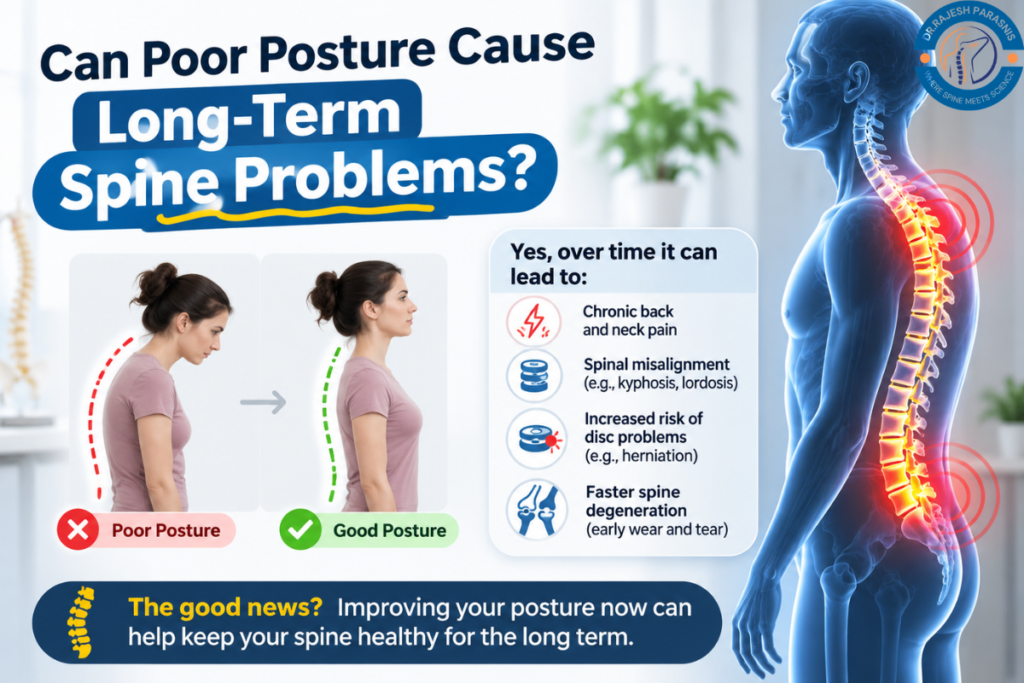
Poor posture is commonly blamed for neck pain, back pain, and “spine damage.” But the relationship between posture and long-term spine problems is more nuanced.
Sitting or standing in one position for long periods can contribute to muscle fatigue, stiffness, and discomfort. However, posture alone does not automatically mean that permanent spinal damage will occur. In many people, symptoms develop because of a combination of prolonged sitting, reduced physical activity, weak or deconditioned muscles, repetitive strain, age-related changes, and individual lifestyle factors.
If you frequently experience neck pain, back pain, stiffness, or discomfort related to prolonged sitting or standing, understanding the role of posture can help you make better decisions about spine health.
For patients seeking evaluation of persistent neck or back symptoms in Pune, Dr. Rajesh Parasnis provides assessment and treatment planning based on the individual’s symptoms, examination findings, lifestyle, and imaging when required.
Can Poor Posture Really Affect the Spine?
Poor or sustained posture can place additional stress on muscles, ligaments, joints, and other structures around the spine.
For example, sitting with the head pushed forward for long periods may increase muscular demand around the neck and shoulders. Similarly, prolonged slouching while working at a desk may contribute to stiffness or lower back discomfort.
Over time, people may notice:
- Neck stiffness
- Upper back discomfort
- Lower back pain
- Shoulder tightness
- Muscle fatigue
- Headaches related to neck tension
- Reduced flexibility
- Discomfort after prolonged sitting
These symptoms are often related to prolonged loading and reduced movement rather than posture being the only cause.
Does Poor Posture Cause Permanent Spine Damage?
Not necessarily.
The human spine is designed to move and tolerate different positions. There is no single “perfect posture” that must be maintained throughout the entire day.
The bigger concern is often staying in one position for too long.
Repeatedly sitting, standing, or bending in the same position without regular movement can increase muscular fatigue and discomfort. In some individuals, this may aggravate an existing spinal condition.
However, long-term spine problems such as disc degeneration, arthritis, spinal stenosis, or spondylosis usually have multiple contributing factors, including:
- Age
- Genetics
- Previous injuries
- Repetitive physical strain
- Smoking
- Reduced physical activity
- Occupational demands
- Body weight
- Existing medical conditions
Posture may influence symptoms, but it should not automatically be considered the sole cause of spinal degeneration.
Why Does Bad Posture Cause Neck Pain?
One commonly discussed example is forward head posture.
When you spend long periods looking downward at a phone, laptop, or desk, the muscles around the neck and upper back may need to work harder to support the head.
This may lead to:
- Neck pain
- Shoulder tightness
- Upper back stiffness
- Muscle fatigue
- Difficulty turning the neck comfortably
Changing position regularly, improving workstation ergonomics, and strengthening the surrounding muscles can help reduce strain in many people.
Can Sitting for Long Hours Cause Back Problems?
Prolonged sitting can contribute to lower back discomfort, particularly when combined with low physical activity.
People working at a computer may sit for several hours without changing position. This can cause stiffness and fatigue in the lower back, hips, and surrounding muscles.
It is useful to remember that the problem is not always simply “sitting incorrectly.”
Even sitting in a technically good posture for several hours without moving can become uncomfortable.
A more practical approach is to combine:
- Comfortable sitting posture
- Regular movement
- Short standing breaks
- Walking
- Stretching
- Strengthening exercises
- Appropriate workstation setup
Can Poor Posture Cause a Slipped Disc?
Poor posture alone does not necessarily cause a slipped or herniated disc.
Disc problems can develop due to age-related changes, repetitive loading, lifting injuries, genetic factors, or other mechanical stresses.
However, certain repetitive activities or prolonged awkward positions may aggravate existing disc-related symptoms in some people.
A slipped disc may cause symptoms such as:
- Back pain
- Pain travelling into the leg
- Numbness or tingling
- Muscle weakness
- Sciatica
If these symptoms are persistent, a clinical evaluation may be helpful.
Can Posture Cause Cervical Spondylosis?
Cervical spondylosis refers to age-related degenerative changes in the neck.
Poor posture does not directly explain every case of cervical spondylosis. Ageing, genetics, occupation, repetitive strain, and previous injuries may also contribute.
However, sustained awkward neck positions may increase discomfort in people who already have cervical degeneration.
In such cases, posture modification may help manage symptoms even though it does not reverse the underlying age-related changes.
What Is the Best Posture for Spine Health?
Rather than trying to maintain one rigid posture all day, aim for a comfortable and supported position that allows regular movement.
While sitting:
- Keep your feet supported
- Avoid leaning excessively to one side
- Position your screen around comfortable eye level
- Keep the keyboard and mouse within easy reach
- Support the lower back if needed
- Avoid remaining in the same position for very long periods
While standing:
- Distribute weight comfortably
- Avoid locking the knees for long periods
- Change position regularly
- Avoid prolonged leaning to one side
The key principle is simple:
Your next posture is often more important than your “perfect” posture.
Regular movement matters.
How Often Should You Take a Break From Sitting?
There is no single schedule that suits everyone, but frequent short movement breaks are generally more practical than sitting continuously for several hours.
You can consider:
- Standing periodically
- Walking for a few minutes
- Changing sitting position
- Stretching the neck and shoulders
- Moving the hips and lower back
Even brief movement can help reduce stiffness and muscular fatigue.
Can Exercise Improve Posture?
Yes, appropriate exercise can support better posture and movement control.
Helpful areas may include:
- Core strengthening
- Back strengthening
- Neck and shoulder exercises
- Hip mobility
- Hamstring flexibility
- Balance training
- General aerobic activity
The most appropriate exercises depend on your symptoms and overall health.
If you already have persistent neck pain, back pain, weakness, numbness, or a diagnosed spine condition, it is sensible to seek medical or physiotherapy guidance before beginning an intensive exercise programme.
Can Mobile Phone Use Affect Neck Posture?
Long periods of looking downward at a phone can contribute to neck discomfort in some people.
The problem is usually not the phone itself but the duration and position.
You can reduce strain by:
- Raising the phone closer to eye level
- Avoiding prolonged downward viewing
- Taking regular breaks
- Changing position frequently
- Avoiding using the phone for long periods while lying awkwardly
These small changes may reduce muscle fatigue.
Does Posture Matter While Sleeping?
Sleeping position can influence comfort, especially if you already have neck or back pain.
There is no single ideal sleeping position for everyone.
Many people are comfortable sleeping on their back or side with appropriate pillow support. The aim is to keep the neck and spine in a comfortable position rather than forcing a particular alignment.
If you frequently wake with pain or stiffness, your sleeping position, pillow, mattress, or an underlying spine condition may need assessment.
When Is Back or Neck Pain More Than Just a Posture Problem?
Persistent pain should not automatically be blamed on posture.
Medical evaluation may be appropriate if symptoms include:
- Pain lasting for several weeks
- Increasing neck or back pain
- Pain travelling into the arm or leg
- Numbness or tingling
- Muscle weakness
- Difficulty walking
- Balance problems
- Loss of hand coordination
- Pain after significant trauma
- Symptoms affecting sleep or daily activities
These symptoms may indicate nerve or spinal cord involvement and should be assessed properly.
When Should You Seek Urgent Medical Attention?
Seek urgent medical evaluation if back or neck symptoms are associated with:
- Sudden severe weakness
- Loss of bladder or bowel control
- Numbness around the groin or inner thighs
- Significant difficulty walking
- Severe pain following major trauma
- Rapidly worsening neurological symptoms
Such symptoms require prompt assessment.
How Are Posture-Related Spine Problems Evaluated?
A spine specialist may ask about:
- Your occupation
- How long you sit each day
- Your workstation
- Exercise habits
- Previous injuries
- Location of pain
- Symptoms in the arms or legs
- Duration of symptoms
The examination may assess posture, spinal movement, muscle strength, reflexes, sensation, and neurological function.
Imaging such as an X-ray or MRI is not required for every case of posture-related discomfort. It may be recommended when symptoms, examination findings, or neurological signs suggest a need for further investigation.
Does Everyone With Back Pain Need a Spine Surgeon?
No.
Many cases of mild neck or back pain can be managed with appropriate activity, exercise, physiotherapy, ergonomic changes, and medical treatment.
A spine surgeon’s role is not limited to surgery. Evaluation can also help determine whether symptoms are mechanical, neurological, degenerative, or related to another cause.
Surgery is generally considered only when clinically appropriate.
Spine Consultation in Pune
If neck pain, back pain, stiffness, numbness, weakness, or posture-related discomfort continues despite appropriate self-care, a medical assessment may help identify the underlying cause.
Dr. Rajesh Parasnis, a spine surgeon in Pune, evaluates patients with conditions including neck pain, back pain, slipped disc, sciatica, spinal stenosis, cervical spondylosis, spinal cord compression, and other spine-related problems.
The goal of consultation is to understand the patient’s symptoms, lifestyle, physical examination findings, and investigations before recommending an appropriate treatment plan.
Depending on the condition, treatment may involve lifestyle modification, physiotherapy, medication, rehabilitation, minimally invasive treatment, or surgery when necessary.
Frequently Asked Questions
Can bad posture cause permanent back problems?
Poor posture may contribute to muscular strain and discomfort, but long-term spine conditions usually have several contributing factors. Persistent symptoms should be evaluated rather than assuming posture is the only cause.
Can posture cause neck pain every day?
Yes, prolonged or repetitive neck positions can contribute to ongoing neck discomfort, especially when combined with long screen time and limited movement.
Is sitting straight all day good for the spine?
Not necessarily. Staying rigidly upright for hours can also cause fatigue. Comfortable posture combined with regular movement is generally more practical.
Can improving posture cure back pain?
Posture changes may reduce symptoms in some patients, but back pain can have many causes. Persistent or severe pain requires proper assessment.
Can poor posture cause nerve compression?
Posture alone is not usually the only cause of significant nerve compression. However, certain positions may worsen symptoms in people who already have conditions such as disc problems or spinal stenosis.
Should I get an MRI for posture-related back pain?
Not everyone needs an MRI. Imaging is usually considered based on symptoms, examination findings, neurological signs, duration of symptoms, and clinical suspicion.
Conclusion
Poor posture can contribute to neck pain, back discomfort, muscle fatigue, and stiffness, especially when the body remains in one position for long periods.
However, posture should not be viewed as the sole cause of every long-term spine problem.
A healthy approach to spine care includes regular movement, physical activity, appropriate strengthening, good workstation ergonomics, and attention to persistent symptoms.
If your pain continues, worsens, or is associated with numbness, weakness, walking difficulty, or other neurological symptoms, professional evaluation can help determine whether an underlying spine condition is present.
For evaluation of persistent neck or back symptoms in Pune, patients may consult Dr. Rajesh Parasnis for diagnosis and individualized spine care.
Website: https://punespinesurgeon.com/