
Open Spine Surgery vs Endoscopic Spine Surgery: Which Is Better?
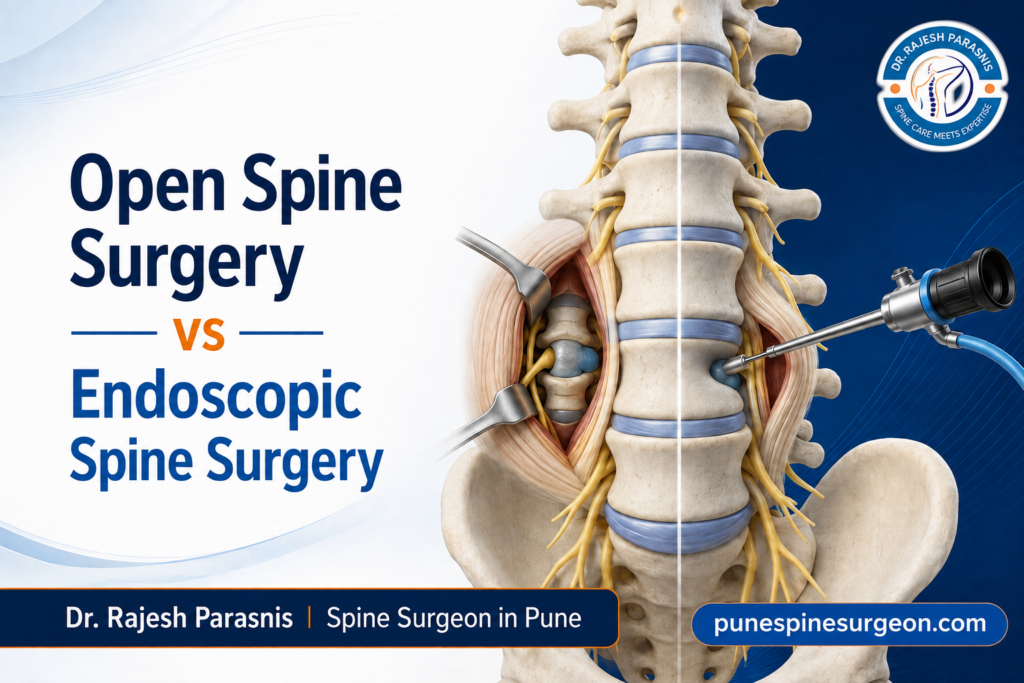
When surgery is recommended for persistent back pain, nerve compression, a slipped disc or spinal stenosis, patients often ask whether open spine surgery or endoscopic spine surgery is the better option. Endoscopic surgery is commonly associated with smaller incisions and faster recovery, while open surgery may provide wider access for complex spinal problems. However, one method is not universally better than the other. The right surgical approach depends on the exact diagnosis, the number of spinal levels involved, the extent of nerve compression, spinal stability and the patient’s overall health. A detailed examination and review of MRI or CT findings by an experienced Spine Surgeon in Pune can help determine which technique is most appropriate. What Is Open Spine Surgery? Open spine surgery is a conventional surgical approach in which the surgeon makes an incision large enough to directly see and reach the affected part of the spine. The muscles and other tissues may need to be carefully moved aside to provide adequate access to the vertebrae, discs and compressed nerves. Open surgery may be used for procedures such as: Spinal decompression or laminectomy Complex spinal fusion Correction of spinal deformities Surgery involving multiple spinal levels Treatment of severe spinal instability Removal of certain spinal tumours Revision surgery following a previous spinal operation Although open surgery involves a larger incision, it allows the surgeon to clearly access a wider surgical area. This may be particularly important when extensive decompression, reconstruction or stabilisation is required. What Is Endoscopic Spine Surgery? Endoscopic spine surgery is a minimally invasive technique performed through a small incision. A thin instrument known as an endoscope, which contains a camera and light source, is inserted through a narrow surgical channel. The camera provides an enlarged view of the affected spinal structures on a monitor. According to the American Academy of Orthopaedic Surgeons, endoscopic discectomy is an advanced minimally invasive technique that may be used to remove a herniated disc in the lower back. Endoscopic spine surgery may be considered for selected conditions, including: Certain types of lumbar disc herniation Nerve root compression Sciatica caused by a slipped disc Selected cases of spinal canal or foraminal narrowing Some recurrent disc problems Persistent leg pain linked to localised nerve compression Not every spinal condition can be treated endoscopically. The location and size of the problem, spinal alignment and the presence of instability must be carefully assessed before recommending this approach. How Are the Two Procedures Different? The main difference lies in how the surgeon reaches the affected area. Open surgery creates a wider operative field, whereas endoscopic surgery uses a narrow working channel and camera. Size of the incision Open spine surgery generally requires a comparatively larger incision. Endoscopic surgery is performed through a much smaller incision, sometimes measuring only a few millimetres. Effect on surrounding tissues During open surgery, more muscle and soft tissue may need to be moved to expose the spine. An endoscopic procedure is designed to reach the problem through a targeted pathway with less disruption to the surrounding muscles. Surgical visibility Open surgery gives the surgeon a direct and wider view of the operative area. In endoscopic surgery, the surgeon works using a magnified camera view displayed on a screen. Recovery period Recovery depends on the actual procedure, diagnosis and individual health. Endoscopic surgery may allow earlier mobilisation and a shorter hospital stay in appropriately selected patients. Recovery after extensive open decompression or fusion may take longer because more tissue and bone work may be involved. Conditions that can be treated Endoscopic techniques are particularly useful for selected, localised problems. Open surgery remains important for complex conditions that require broad decompression, correction of deformity, fusion or treatment across several spinal levels. Potential Benefits of Endoscopic Spine Surgery The American Association of Neurological Surgeons notes that minimally invasive techniques may offer benefits such as less blood loss, reduced muscle damage, smaller scars and faster recovery in suitable cases. Possible benefits of endoscopic surgery include: Smaller surgical incision Reduced disturbance of muscles and soft tissues Potentially less postoperative discomfort Lower blood loss in many procedures Shorter hospitalisation in selected patients Earlier return to routine activities Smaller surgical scar These are potential advantages rather than guaranteed outcomes. Results depend on selecting the right patient, treating the correct pain source and performing the procedure safely. When May Open Spine Surgery Be More Appropriate? A smaller incision should not be the only factor used to choose a surgical technique. Open surgery may be safer or more effective when the condition is too extensive to treat through a narrow endoscopic channel. A Spine Surgeon in Pune may recommend an open procedure when a patient has: Severe or multilevel spinal stenosis Significant spinal instability Spondylolisthesis requiring fusion Major spinal deformity Complex fractures or tumours Extensive nerve compression Previous surgery with significant scar tissue A condition requiring screws, rods or other implants In these situations, wider access may allow the surgeon to perform complete decompression, restore stability and address multiple structural problems during the same operation. Does Endoscopic Surgery Have Any Risks? Endoscopic spine surgery is still a surgical procedure and is not free from risk. Possible complications may include infection, bleeding, nerve irritation, spinal fluid leakage, incomplete relief or recurrence of disc herniation. There may also be situations where the planned endoscopic procedure needs to be converted to a more extensive approach to treat the condition safely. Open spine surgery carries similar general surgical risks. The NHS lists potential complications of lumbar decompression surgery such as infection, spinal fluid leakage, nerve injury, persistent pain and spinal instability. The individual risk varies according to the procedure, medical history and severity of the spinal problem. Is Endoscopic Spine Surgery Always Better? No. Endoscopic spine surgery can be an excellent option for the right diagnosis, but it is not automatically the best choice for every patient. A small incision does not guarantee a better result. The primary purpose of surgery is to adequately relieve nerve compression, protect neurological function and stabilise the spine
Open Spine Surgery vs Endoscopic Spine Surgery: Which Is Better? Read More »